
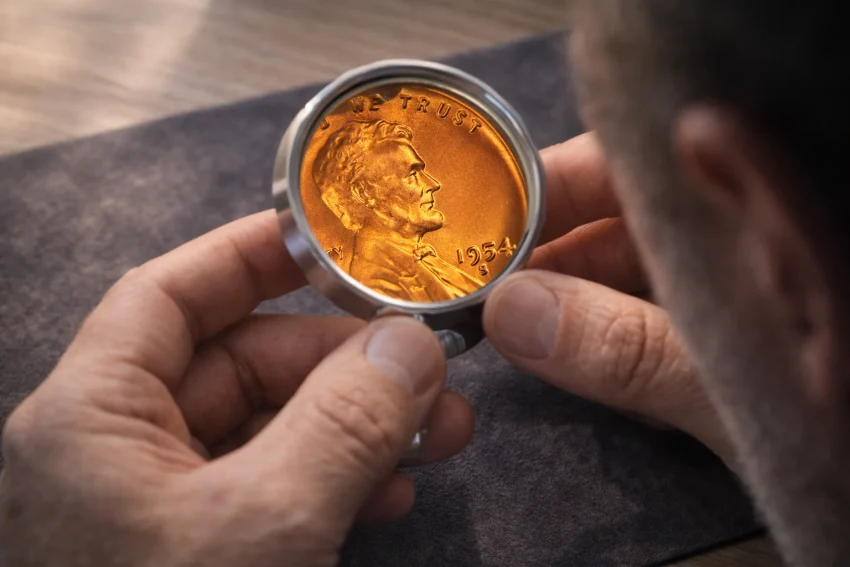
The 1954 wheat penny is often labeled as a common late-series Lincoln cent. That label is accurate in low grades. It becomes less accurate in higher Mint State levels. The date is not rare by mintage, but becomes scarce by condition.
Collectors often ignore 1954 because it sits near the end of the Wheat series. Attention usually goes to earlier key dates or to the famous 1955 doubled die. That leaves 1954 in a quiet position. So, is it just another common date, or does it hide conditional rarity?
The answer depends on grade, color, and mint.
Production Numbers and Mint Comparison
The 1954 cent was struck at three mints.
| Mint | Mintage | General Availability |
| 1954 (P) | ~71,640,000 | Common |
| 1954-D | ~251,552,500 | Very Common |
| 1954-S | ~96,190,000 | Moderately Available |
Denver produced by far the largest number. Philadelphia had the lowest mintage of the three. San Francisco falls between them.
Despite this difference, none of the three is a key date. All are available in circulated grades. The separation appears when you examine higher preservation levels.
Philadelphia has the lowest mintage of the three issues. However, availability in Mint State does not strictly follow mintage figures. Denver coins are extremely common in lower grades, while well-preserved San Francisco examples in higher grades can be more difficult to locate.
Mintage alone does not define value here, but preservation does.
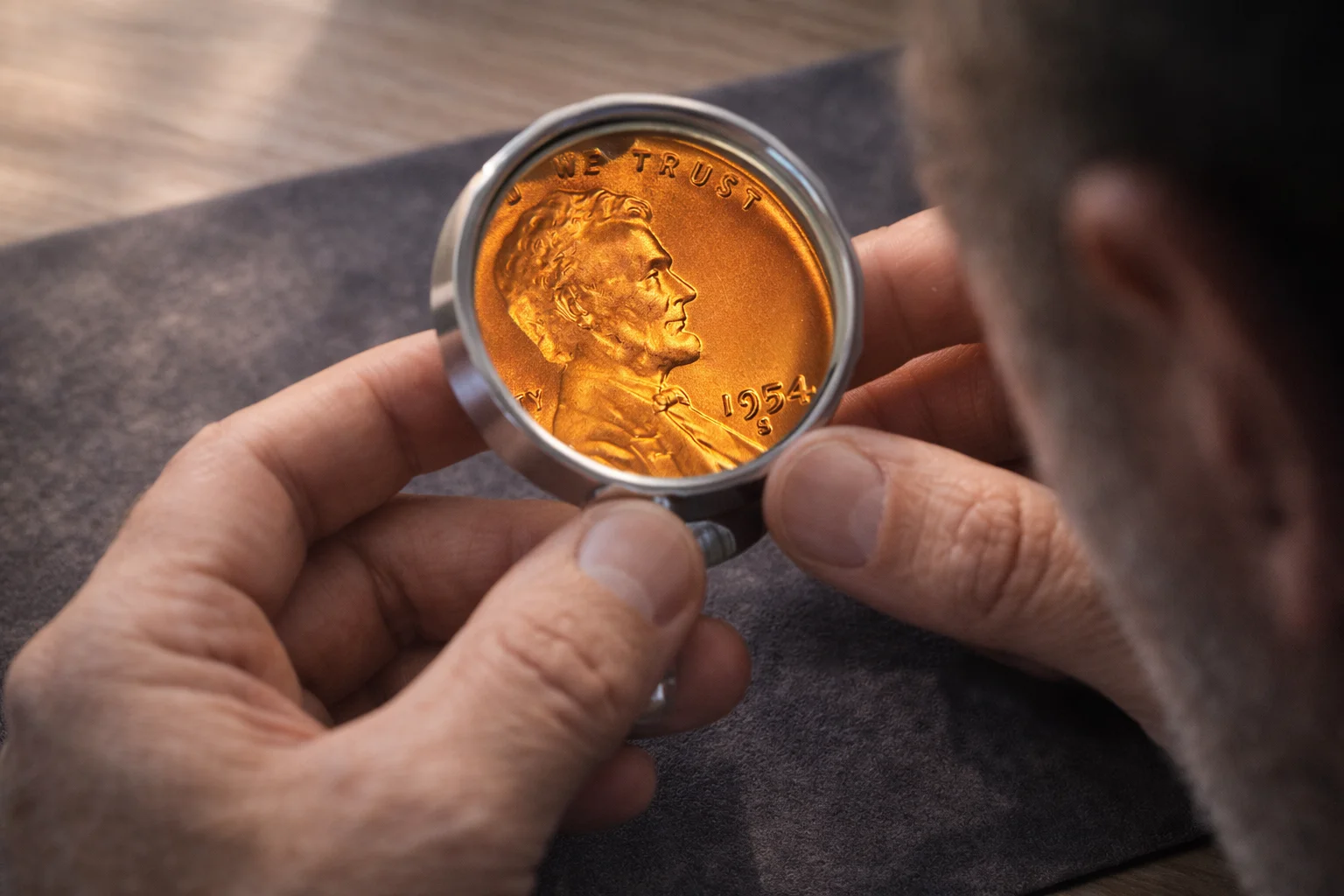
Basic Specifications
| Feature | Detail |
| Year | 1954 |
| Composition | 95% copper, 5% tin, and zinc |
| Weight | 3.11 g |
| Diameter | 19.05 mm |
| Edge | Plain |
These coins are bronze. They are not clad. They are not steel. Copper composition allows color grading: Brown (BN), Red Brown (RB), and Red (RD). Color plays a large role in higher grades.
What about the Value?
Circulated Grades: Most Coins Stay Cheap
In worn condition, 1954 cents remain inexpensive.
| Grade | 1954 | 1954-D | 1954-S |
| G4 | $0.05–$0.10 | Face value | $0.10–$0.20 |
| VF20 | $0.15–$0.30 | $0.10–$0.25 | $0.25–$0.50 |
Most examples were heavily used. In Good or Very Fine, detail on Lincoln’s hair and the wheat stalks is reduced. These coins trade at modest levels. Denver pieces are the most common. San Francisco commands a small premium due to slightly lower availability.
In this range, there is no rarity. These are type-set fillers.
XF to AU: Slight Premium, Still Common
When coins reach Extremely Fine or About Uncirculated, wear becomes light. The detail is sharper. Luster may remain in protected areas.
| Grade | 1954 | 1954-D | 1954-S |
| XF40 | $0.40–$0.75 | $0.25–$0.60 | $0.75–$1.50 |
| AU50 | $1–$2 | $0.75–$1.50 | $2–$4 |
The increase is visible but not dramatic. Denver remains the least expensive. San Francisco gains strength as the grade rises.
At this stage, eye appeal matters. Clean surfaces and even color help. Still, these coins are not scarce.
Mint State: Where the Date Changes Character
Once you enter Mint State, the conversation shifts. Wear disappears. Surface preservation becomes critical.
Brown Examples (BN)
| Grade | 1954 | 1954-D | 1954-S |
| MS63 BN | $5–$10 | $3–$8 | $10–$20 |
| MS65 BN | $15–$35 | $10–$25 | $25–$60 |
Philadelphia and Denver remain affordable. San Francisco begins to separate in MS65 Brown. Clean S-mint coins are harder to find without marks.
In MS63, small ticks are allowed. In MS65, surfaces must be cleaner and luster stronger.
This is the point where condition begins to matter more than mintage.
The Conditional Rarity Zone: MS66 and MS67
The “sleeper” argument begins here.
In MS66, coins must show strong strike and limited contact marks. In MS67, surfaces must be nearly flawless. For a late Wheat cent, this is difficult.
Approximate ranges for 1954-S Red:
| Grade | Approximate Value |
| MS66 RD | $140–$220 |
| MS67 RD | $600+ |
Philadelphia and Denver can also reach similar levels in top grades, but San Francisco often leads in premium.
These coins are not rare because few were struck. They are rare because few survived without marks.
A single noticeable hit can drop a coin from MS67 to MS66. That drop may reduce value by half or more.
This is a conditional rarity. The date is common. The condition is not.
Color: The Multiplier Effect
Copper changes over time. Red surfaces tone brown unless protected. Late Wheat cents have better survival of red color compared to 1920s issues, but full Red at high grades still carries a premium.
Let’s take, for example, 1954-S in MS65.
| Color | Approximate Value |
| BN | $50 |
| RB | $75 |
| RD | $125+ |
The shift from Brown to Red can double the value. In MS66 and MS67, the gap grows larger.
Red examples must retain strong original luster. Artificial brightness does not count. Cleaning reduces value.
For collectors building registry sets, the RD designation matters. It separates ordinary Mint State coins from premium examples.
Strike Quality and Typical Weakness
Late Wheat cents sometimes show softness in central detail. Wheat lines may lack full separation. Lincoln’s hair may appear slightly flat even in uncirculated condition.
Strong strike indicators include:
- Clear wheat lines.
- Bold lettering.
- Defined rim.
A weak strike does not automatically lower the grade, but it affects eye appeal. In the MS67 competition, strike clarity can determine the final price.
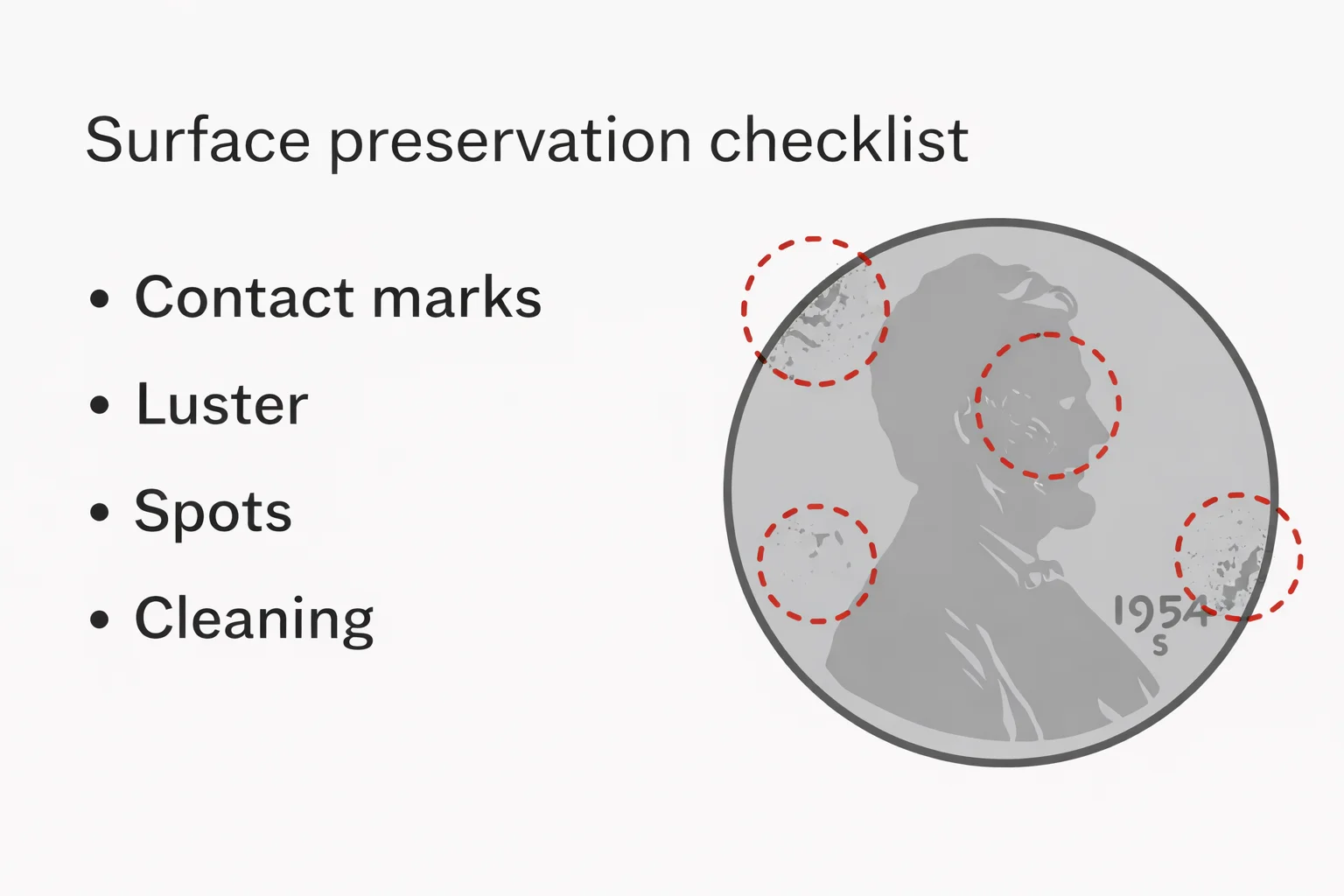
Surface Preservation: The Real Barrier
Most 1954 cents were stored in bags. Contact between coins left marks before circulation.
Common issues:
- Small nicks in fields.
- Light scratches.
- Dull luster.
- Spots from storage.
High-grade coins require minimal distractions. Original surfaces matter more than brightness. Cleaning, polishing, or chemical treatment lowers value.
For 1954, preservation is the limiting factor.
Key 1954 Penny Errors and Varieties
Errors exist, but they do not redefine the date.
Repunched Mint Marks (RPM)
1954-D RPM varieties are known. Multiple examples show clear repunching of the “D.” These attract interest but usually sell for moderate premiums.
1954-S/S RPM, including the S/S Northwest variety, often trade in the $17–$25 range in circulated grades. Higher grades can bring more.
RPM coins are collectible, not rare.
“L” on Rim / Edge
This is a strike-position variation, not a recognized variety. Some 1954-D and 1954-P cents show the “L” in LIBERTY touching the rim. This results from die alignment and strike pressure.
Premium is minor. The feature is interesting but common enough to limit price impact.
Lamination Errors
1954-S examples with lamination cracks show metal separation or peeling. Strong lamination errors draw collector interest.
Value depends on visibility. Light laminations bring small premiums. Dramatic splits increase price.
Misplaced Mint Marks and Date Errors
Some 1954-S coins show the mint mark touching the date or a small “tail” on the 5. Clear examples can sell above common levels but remain accessible.
Attribution requires magnification. Certification helps in higher-value cases.
Struck Through Grease
Grease-filled dies can produce missing letters or weak digits. These coins show incomplete design elements.
Premium is usually small unless the missing detail is dramatic.
Broadstrike
Broadstrike errors occur when the coin is struck outside the collar. The coin appears wider and thinner. Strong examples can bring higher premiums, especially in Mint State.
Overall, 1954 errors are collectible but not market-defining. Grade remains the main driver.
Comparison with 1955
1955 is famous for the Doubled Die Obverse. That variety transformed the market for the year.
1954 does not have a comparable major doubled die. There is no single headline variety that dominates pricing.
That difference keeps the 1954 values stable. It prevents sudden spikes based on a single error type.
Where 1955 attracts attention for a dramatic variety, 1954 depends on the condition and color.
Finally, Is 1954 a Conditional Sleeper?
In circulated grades, no. It remains common and inexpensive.
In Mint State Brown, still accessible.
In MS66 and MS67 Red, the picture changes. Population numbers thin out. Auction records show strong results for top-end pieces.
That does not make it a hidden key date. It makes it condition-sensitive.
Collectors building high-grade Wheat sets must include 1954. Competition at the top pushes prices upward.
For lower grades, the date remains affordable. For quick verification of mint mark, composition, and basic details, tools like Coin ID Scanner can assist. A clear photo generates a coin card with technical data and an estimated market range. That helps with initial sorting before deeper grading analysis.
The conclusion is direct. Most 1954 cents remain inexpensive. The finest preserved examples tell a different story. In this year, condition separates ordinary from exceptional.